


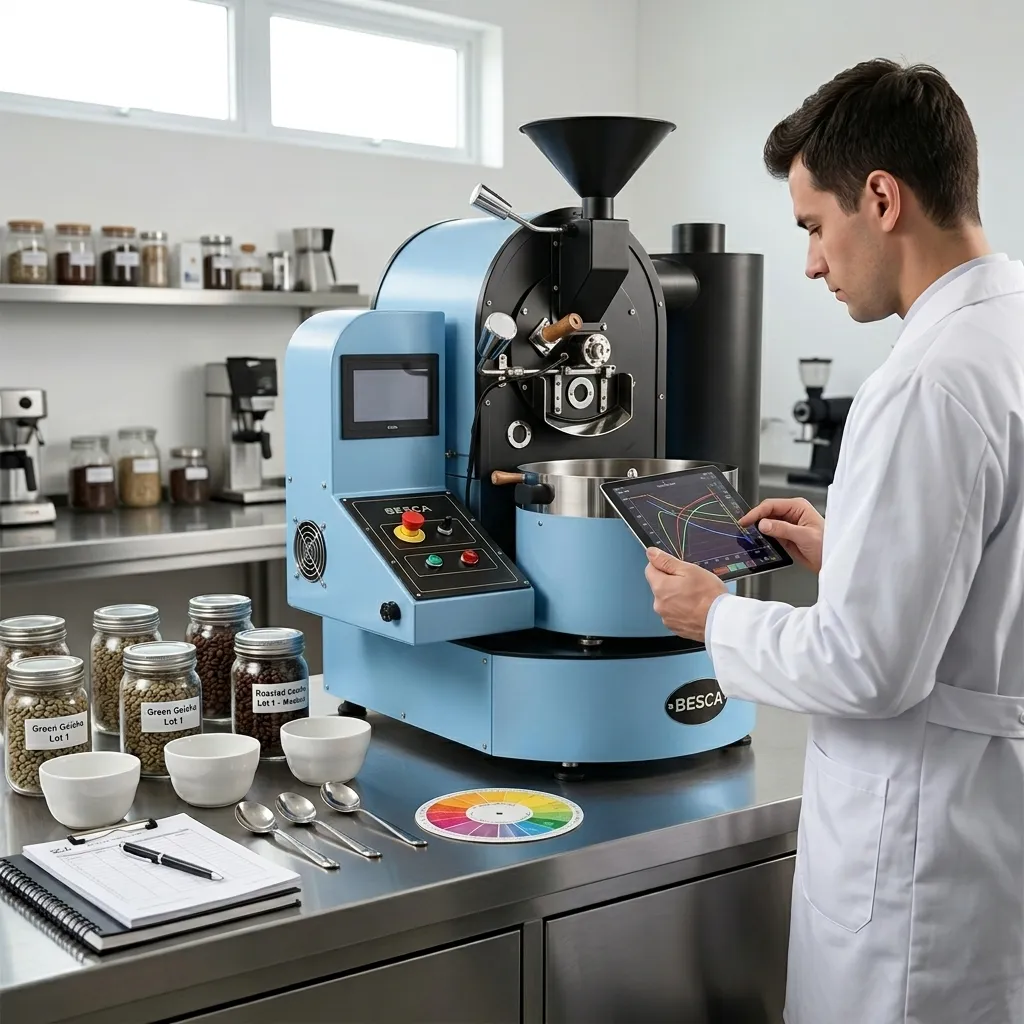
The path to the perfect production roast doesn’t begin with a 30kg machine running at full capacity; it begins in the quiet, focused environment of the laboratory. Laboratory coffee roasting is the scientific foundation of the specialty coffee industry. It is where raw, green potential is meticulously analyzed, where roasting variables are isolated, and where signature flavor profiles are born. For quality-conscious roasters, importers, and coffee scientists, the sample roaster is not merely an accessory; it is the single most important tool for ensuring consistency, protecting investment, and unlocking the unique culinary stories hidden within every lot of coffee.
This comprehensive guide delves into the masterful art and exact science of laboratory coffee roasting. We will explore the critical role of sample roasters, the techniques required to develop repeatable profiles, and how investing in precision laboratory equipment like Besca Roasters’ specialty series defines the future of your coffee quality.
The Role of the Sample Roaster in Specialty Coffee
In the green coffee supply chain, from farm to fincan, decisions involving millions of dollars and countless hours of labor are made based on 100-gram batches. The sample roaster acts as the gateway of quality control. It provides the initial, crucial representation of what a coffee lot can be.
Why Sample Roasting is Essential for Green Buying
A production manager would never dream of committing to a full container of green coffee without knowing exactly what it tastes like. Green coffee analysis is a complex process. When an offer sample arrives, the lab roaster’s job is to apply a neutral, consistent “cupping roast” that allows the cupper to evaluate the inherent qualities of the bean—acidity, sweetness, body, cleanliness, and defects—without overwhelming them with roast flavor.
Sample roasting for green buying is not about finding the perfect commercial profile; it is about transparency. The lab roaster must be nimble enough to roast multiple samples back-to-back quickly, yet precise enough to ensure that the third roast is roasted identically to the first, isolating the only variable: the coffee itself.
Bridging the Gap to Production Roasting
The laboratory is also where the production roaster’s work is lightened. Instead of wasting 15kg of expensive green coffee on experimental profiles, roasters use the laboratory roaster to perform test roasts. They can roast samples to slightly different end temperatures, use varying RoR (Rate of Rise) strategies, or manipulate development time. Once the lab cupping panel identifies the winning profile, the data can be transposed to the production machine. Modern specialty lab roasters, like the Besca BSC-01, make this transition smoother through digital profile integration, turning laboratory data into production reality.
Inside Besca’s Laboratory Innovation: The BSC-01 1KG Specialty Roaster
When Besca Roasters engineered the BSC-01, the goal was not simply to make a smaller roaster. The goal was to build a scientific instrument capable of providing industrial-level control within a tabletop footprint. A laboratory roaster must be a miniature champion, offering the same thermodynamic control as its larger counterparts.
Thermodynamics at a Miniature Scale
At the 1kg scale, heat control must be extremely responsive. Green beans react faster, and the small drum temperature can fluctuate rapidly. A superior laboratory roaster uses high-precision burners or elements (like Besca’s premix burners) that can respond instantly to adjustments. Furthermore, the insulation must be advanced to prevent ambient temperature from skewing the roast data.
Premix Burner and Hot Air Control
The ability to control hot air flow is paramount. In a lab environment, roasters often work with delicate or exotic beans (Geishas, advanced fermentations). Controlling whether the heat transfer is predominantly conductive or convective allows the roaster to highlight either the floral/acidic notes or the body/sweetness. The BSC-01 provides this maester level of control, allowing roasters to fine-tune Sirocco fan levels with tactile precision.
The Importance of High-Precision Probes and Sensors
Laboratory roasting data is only as good as the tools measuring it. Inferior, slow-responding thermocouples can hide defects in the roast curve, leading to false conclusions during cupping. A precision instrument must use fast-response probes—ideally 1.5mm to 3mm diameter—positioned perfectly in the bean pile and the exhaust airflow. Besca integrates high-standard sensors that feed real-time, granular data into control panels and profiling software, ensuring every small flicker of heat change is registered and analyzed.
Technical Techniques for Masterful Laboratory Roasting
Possessing a precision lab roaster is only the first step. The true craft of laboratory roasting lies in technique—how the roaster operates the machine to generate meaningful, repeatable data.
Establishing the Neutral Cupping Roast
The primary objective of most laboratory roasting is the cupping evaluation. The Specialty Coffee Association (SCA) has guidelines for this “cupping roast.” The goal is a light to medium-light roast, typically reaching a first crack between 7:00 and 9:00 minutes, with a total roast time under 12:00 minutes. The resulting color must be highly consistent (often measured on Agtron or similar color scales). A neutral roast prevents caramelization or roasting roasts from overpowering the coffee’s origin flavor characteristics. The Besca BSC-01’s consistent performance is crucial here, allowing the lab technician to perform multiple SCA standard roasts with unwavering accuracy.
Managing the Rate of Rise (RoR) in Small Batches
RoR is the speedometer of your roast. In a 1kg roaster, RoR can be notoriously jumpy. Maintaining a smooth, steadily declining RoR is more difficult than on a 30kg machine. Laboratory technicians must master pre-heating the drum meticulously and managing the airflow adjustments before First Crack.
Profile Development and Experimental Roasting
Once green buying analysis is complete, the laboratory shifts its purpose to product development. This is experimental roasting. Roasters can deliberate introduce “flaws” or extreme profile shapes to see how a bean reacts.
-
Manipulating Development Time: How does changing the time after First Crack affect sweetness vs. body?
-
Alternative Charge Temperatures: Does a higher charge enhance the perceived acidity of this high-altitude Geisha?
-
Testing Roasting Levels: Roasting the same sample to slightly different color endpoints to find the ideal market balance.
These experiments must be performed on a roaster that offers scientific repeatability. If your lab roaster isn’t thermally stable, you can’t be sure if the taste difference is the bean’s reaction or the machine’s variance.
The Role of Automation and Software in the Laboratory
In the modern laboratory, the notebook and pencil have been replaced by touch screens and data logging. Digital tools have transformed laboratory roasting from an artisanal guessing game into a repeatable science.
Advanced Profile Management Software
Professional software—whether built-in to the Besca interface, or compatible third-party platforms like Cropster or Artisan—records every roast variable in real-time. It plots the bean temperature, exhaust temperature, RoR, air flow, and drum speed against time. The laboratory technician can add digital marks for events like First Crack or the start of cooling. This profile data is the lab’s institutional memory.
Profile Repeating: Replicating Perfection
The single greatest leap in laboratory technology is Profile Repeating (also known as automation or replay). With a modern roaster like the Besca BSC-01, once a masterpiece experimental profile is achieved, the technician can save it. When the next test batch is charged, the machine’s software can automatically adjust burners and fan speeds to replicate that profile’s RoR curve exactly. This level of repeatability is essential for scientific comparison. It turns a lab’s successful prototype into a standardized quality reference.
Translating Laboratory Data to Production
Laboratory automation isn’t about making the roaster’s job easier; it’s about making the entire business smarter. When a lab confirms a roast profile, the automated steps—at what minute to drop the burner, what RoR curve to follow—provide the production team with a technical blueprint. It minimizes waste and gets a new product to market faster.
Conclusion: Investing in Laboratory Scientific Excellence
The laboratory is the heart of quality in specialty coffee. Whether you are an artisan roaster, a scientific researcher, or an importer managing a complex green portfolio, your laboratory roaster defines your standards. Laboratory coffee roasting is the scientific foundation that ensures your customers receive excellence in every cup.
Investing in a high-precision, technologically advanced laboratory roaster, such as Besca Roasters’ specialty and sample series like the BSC-01, is a strategic commitment to quality. When your laboratory can isolate every thermodynamic variable and replicate every successful profile with scientific accuracy, your business moves beyond roasting; it moves into masterful craft, guided by digital data. In a competitive industry that demands unwavering consistency and unique flavor profiles, laboratory excellence is not optional; it is the masterpiece foundation upon which successful coffee brands are built.