


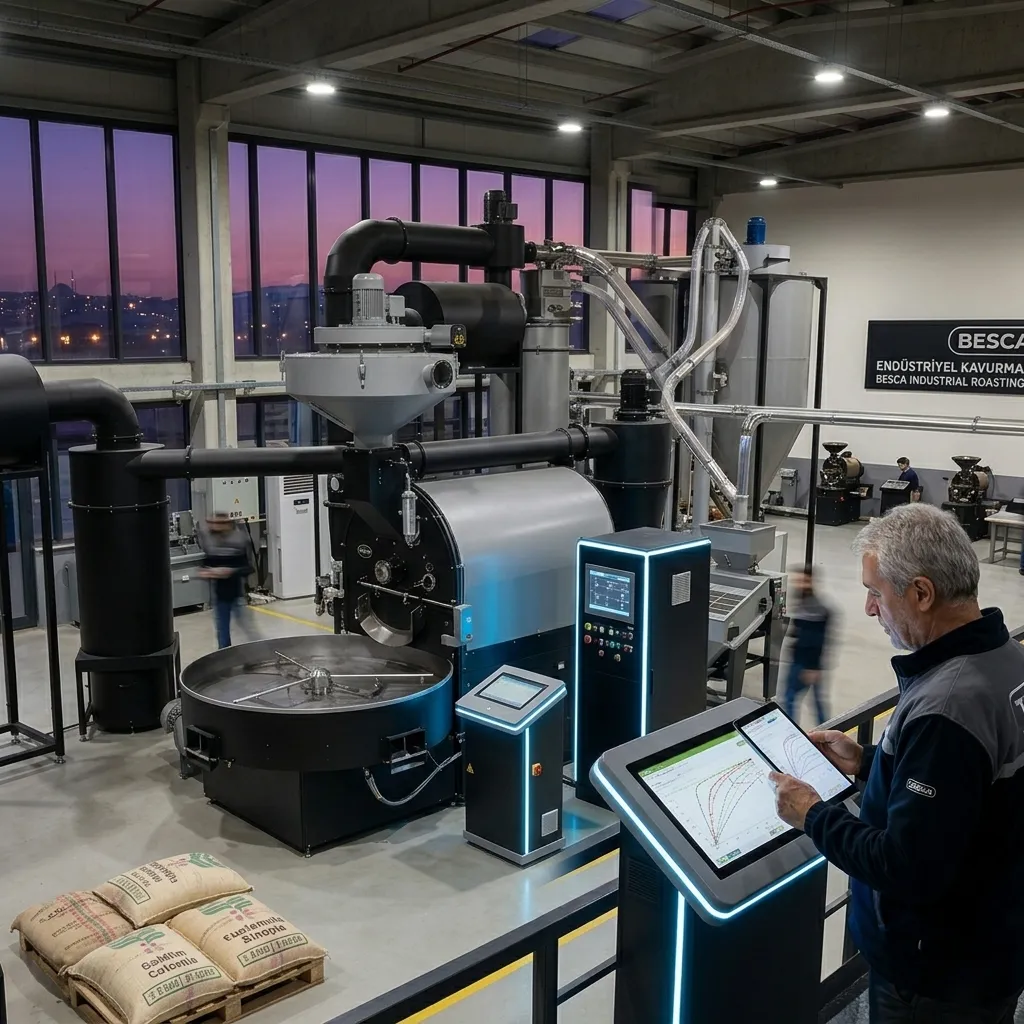
The central dilemma facing growing specialty coffee roasteries is the balancing act between consistency and scalability. You built your reputation on the artisan nuance of every batch, but your wholesale accounts are multiplying, and manual production can no longer keep pace. The leap to commercial-grade equipment is inevitable, yet a question lingers: how do we maintain the signature profile of our award-winning Geisha natural when we multiply our batch capacity by five?
This is where the paradigm of the automated coffee roasting system enters the stage. Far from replacing the master roaster, automated systems are designed to amplify their craft, ensuring that the same passion and precision poured into a 5kg test batch can be applied with scientific accuracy to a 30kg commercial run. This comprehensive guide, running over 2000 words, will explore the technology behind automated commercial roasting, its essential role in maintaining specialty quality, and how investing in a future-proof, Cropster-compatible automated roaster like those from Besca defines the scale and consistency of your roasting empire.
Demystifying Automated Coffee Roasting Systems
When many artisan roasters hear “automation,” they fear a loss of control. They imagine a process where a button is pressed and the machine simply runs a generic dark roast until a timer ends. This is a common and antiquated misconception. In modern commercial roasting, automation is about precision and predictability.
Automation as a Tool for the Roaster’s Art
The purpose of an automated roasting system is to eliminate the human inconsistencies that can plague high-volume production. When a roaster must manage 15 commercial batches in a shift, fatigue, distractions, or a slow reaction time can lead to a slightly different First Crack minute or a different Rate of Rise (RoR) path. These small variances are catastrophic for specialty coffee consistency.
Modern automated roasting systems are Maester technicians. They are programmed by the head roaster to execute their exact signature profile. The software manages the premix burners, fan speeds, and drum speed with millisecond precision, ensuring that the machine replicates the master curve perfectly, every single time. The roaster is liberated from tactile control and is empowered to monitor data analytics, perform quality checks, and manage logistics. The automation owns the consistency; the roaster owns the profile.
Industrial Scalability Meets Scientific Micro-Control
An automated commercial roaster, like the Besca Gen II commercial series (including the BSC-30 and above), must operate at an industrial scale without sacrificing the granular control needed for delicate specialty beans. It requires powerful, responsive heating—such aspremix modulated burners—that can quickly apply a lot of energy to a 30kg batch, but also quickly decrease it to protect the beans’ delicate acids. The thermodynamic requirements of a commercial automated system are significantly higher than those of a manual shop roaster.
The Core Technology Behind Commercial Automation
A commercial roaster is only as good as its thermodynamic and data management systems. To execute a complex specialty profile automatically, the machine must possess industrial reliability and scientific micro-control.
Burner Responsiveness and Premix Technology
For automation to work, the roaster’s heat source must be maester level. Gaseous fuel must be premixed and modulated. This means the roaster’s computer can instantly change the burner output from 20% to 80% with no delay. This immediate heat response is critical for managing the RoR curve after the coffee absorbs a massive amount of heat initial and enters First Crack. Inferior burners will lag behind the automation’s command, making true automated profile replication impossible.
Precision Sensors and Advanced Probes
Laboratory roasting requires data accuracy, but commercial automation requires it and speed. Because a 30kg drum is massive, probes must be fast-response (often 1.5mm to 3mm) and strategically positioned in the dense bean pile and the exhaust airflow. If a sensor is slow, the software will receive outdated temperature data, causing the automated system to apply heat adjustments too late. Besca roasters integrate high-standard sensors that ensure the control computer receives real-time, granular data, essential for maintaining scientific profile repeatability.
The Strategic Advantage of Cropster and Artisan Compatibility
In the digital era, data is institutional memory. For a commercial roaster, profile data must be managed, analyzed, and shared. A closed-loop system is an island. Besca Roasters made a strategic engineering choice: all models are fully compatible with leading professional roasting software platforms like Artisan and Cropster.
Digital Profile Integration: Beyond Simple Data Logging
Data logging is essential, but proper automation requires integration. Cropster or Artisan doesn’t just record a roast; it can communicate with the roaster’s brain. Once the master roaster confirms a signature 5kg profile on their Cropster dashboard, they can instantlyTranspose that blueprint to the automated 30kg commercial machine. The Cropster profile provides the automated system with precise timestamps for every burner adjustment, fan speed change, and drum rotation, ensuring the commercial machine replicates the masterpiece profile path exactly.
Institutional Memory and Remote Problem Detection
Wholesale customers do not trust a brand; they trust a standard. If a 15kg batch of your Costa Rica honey process tastes slightly different, the client will worry. With digital profile management, the quality manager has instant access to every historical roast of that product. They can instantly compare a recent roast data curve against the standard blueprint. If a variance occurred, they can perform root cause analysis. Automation transforms roasting from an artisan craft into a manageable scientific process. Furthermore, Besca’s automated systems allow for remote problem detection and technical help, minimizing downtime and maximizing productivity.
Technical Control Variables in High-Volume Automated Roasting
High-volume automated roasting is the ultimate test of thermodynamic stability and predictive engineering. How do we manage the unique needs of different green beans automatically?
ManagingConductive and Convective Heat Balance
Commercial machines are large, and conductive heat (direct drum contact) can scorch delicate beans if not managed correctly. Modern automated systems offer high-end convective heat control through advanced Sirocco fan modulation. When roasting a Geisha or a delicate floral Ethiopian, the automated system is programmed to increase airflow initially and use gentler conductive heat, allowing the convection to open the beans without burning the surface.
Automating the Rate of Rise (RoR) Path
A smooth, steadily declining RoR is the hallmark of specialty roasting. Achieving this on a 30kg manual drum is difficult. In an automated system, the software is programmed to anticipate First Crack. It automatically starts reducing the premix burner output before the exothermic heat spikes, flattening the RoR curve perfectly. This predictive control prevents an undesired “crash and flick” during Development Time, ensuring that your commercial batches maintain the complexity and body of your smaller, precision laboratory prototypes.
Post-Crack Development Time Control
Development time—the period after First Crack—is where sweetness and body are maximized or muted. Modern automation allows for granular, automated management of this phase. The machine is programmed to drop the temperature to a precise endpoint color, maintaining the roast environment’s stability with maester level accuracy. This ensures that every 30kg commercial batch meets your exact flavor standard.
Conclusion: The Definitive Choice for Scaling Quality and ROI
The specialty coffee market is relentless in its demand for quality, but it is also expanding rapidly. As a growing roastery, your strategic future depends on your ability to scale production without sacrificing consistency.
Automated coffee roasting systems are not a luxury; they are the gateway to scalability. Far from a step back from artistry, automation is the scientific amplification of the master roaster’s skill. Investing in an advanced, future-proof, Cropster-compatible automated system, such as Besca Roasters’ commercial Gen II series, is a commitment to the long-term quality and predictability of your brand. It transforms roasting from an artisan guessing game into a repeatable scientific process. It turns production time into growth time, allowing your master roasters to focus on sourcing, innovation, and global distribution. In an industry defined by nuance and unwavering consistency, automated precision is the masterful craft foundation upon which a thriving, specialty coffee empire is built.